Gaonkaari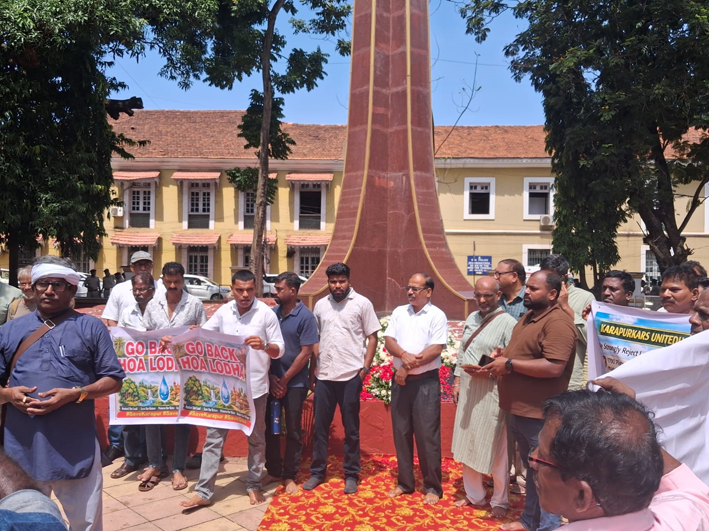
Panaji, June 18 : Marking the historic occasion of Goa Revolution Day (Kranti Din), citizen-led movement Enough is Enough Goa has called upon the state government to immediately pass and implement the proposed Goa Protection of Agricultural Lands Act, 2026, describing it as essential to safeguard Goa’s environment, agricultural heritage and local identity.
Paying tribute to freedom fighters Dr. Ram Manohar Lohia and Dr. Julião Menezes, who launched the struggle for civil liberties in Goa on June 18, 1946, the movement stated that Goa now requires a “second revolution” to protect itself from unchecked real estate development, environmental degradation and large-scale land conversions.
Led by former Chief Justice of the Allahabad High Court, Justice Ferdino Rebello, the movement expressed concern over what it described as growing threats to Goa’s identity through provisions such as Section 39(A) of the Town and Country Planning (TCP) Act. According to the organisation, the provision has enabled the conversion of orchards, ecologically sensitive hill slopes and agricultural lands into settlement zones for luxury housing projects.
Addressing the issue, Justice Rebello noted that Goa’s built-up area had expanded dramatically over the last five decades. He said that between 1973 and 2022, built-up areas increased from 22.2 square kilometres to more than 180.94 square kilometres, while over 1,300 spot-zoning applications had reportedly been submitted to the TCP Department to cater to demand for luxury housing.
“Honouring the sacrifices of our freedom fighters is meaningless if we allow the land they fought to protect to be permanently concretised,” Justice Rebello said.
The proposed Goa Protection of Agricultural Lands Act, 2026, drafted with inputs from legal experts and citizens associated with the movement, seeks to introduce stringent safeguards against land degradation and unplanned development.
Among its key provisions are a complete ban on cutting hills and slopes, filling low-lying agricultural lands, and altering non-developable areas; protection of active and fallow agricultural lands and forest areas from commercial conversion; and mandatory ecological carrying-capacity studies to determine how much population and infrastructure pressure villages can sustainably accommodate.
The movement also stated that the proposed law would have overriding legal effect over conflicting legislation while complementing existing safeguards under the Goa Land Use (Regulation) Act, 1991.
While acknowledging that public pressure had resulted in the suspension of some land conversion proposals in specific locations, the organisation maintained that isolated interventions were insufficient and called for a comprehensive statewide policy to prevent further ecological damage.
“True civil liberty includes ecological security and the protection of local identity,” Justice Rebello said. “On June 18, 1946, Goans stood up against colonial oppression. In 2026, we must stand up against internal exploitation and ensure that the interests of future generations prevail over those of powerful real estate lobbies.”
The movement appealed to citizens, village panchayats and civil society organisations across Goa to unite in support of the proposed legislation and work collectively to protect the state’s agricultural lands, hills and natural resources.