Gaonkaari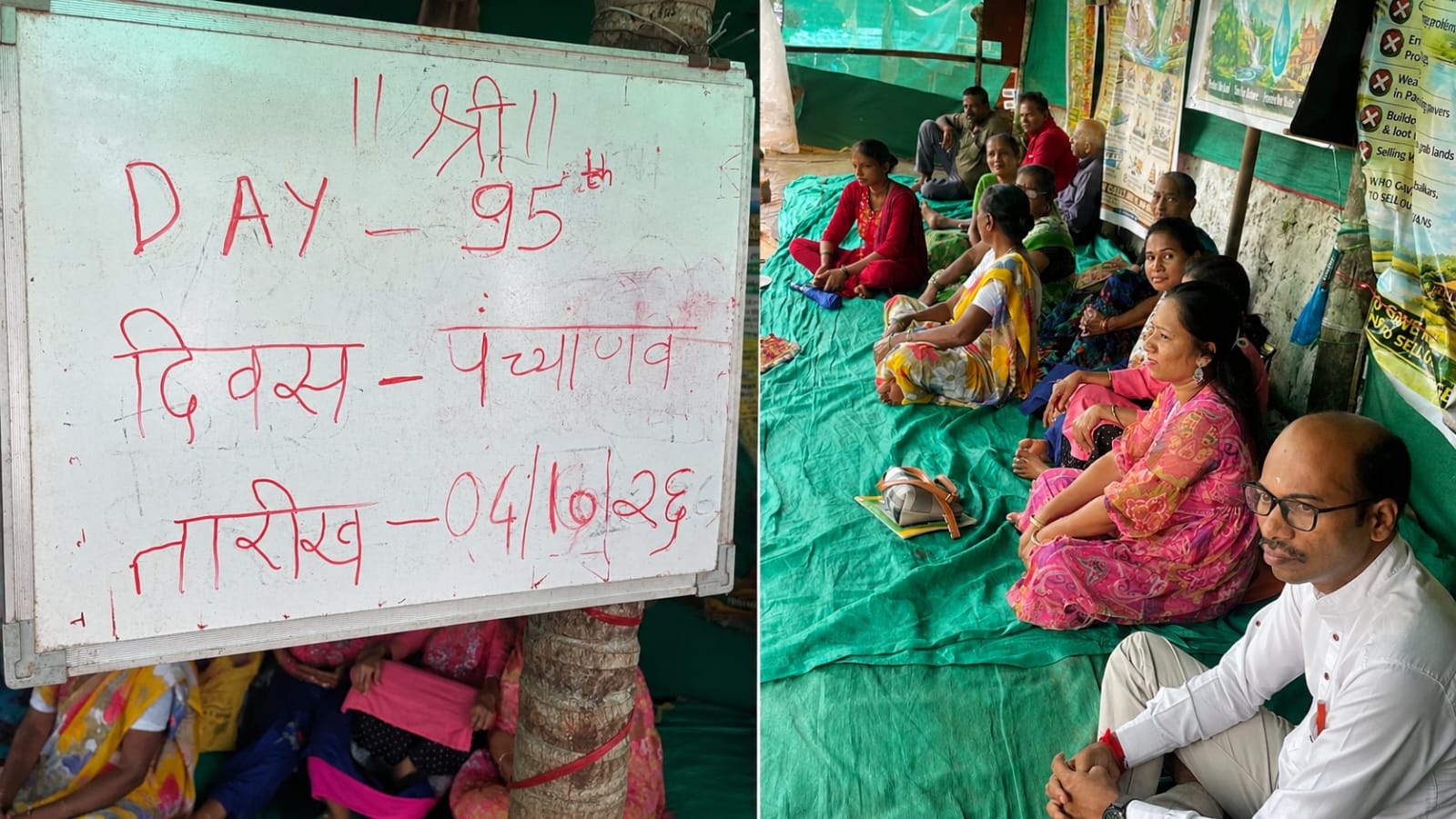
Kishor Naik Gaonkar
On 13 July, the people of Karapur-Sarvan will complete 100 days of an extraordinary struggle. For one hundred consecutive days, ordinary villagers have stood firm to protect their village, their agricultural lands, orchards, river, and the future of generations yet to come. That such a prolonged struggle has become necessary is not a matter of pride for Goa—it is a matter of collective shame.
These hundred days are not merely a milestone in a protest. They are one hundred days of unanswered questions, one hundred days of government silence, and one hundred days of remarkable courage shown by ordinary citizens who refuse to surrender their homeland.
The people of Karapur are not fighting against development. They are fighting against injustice.
They have not demanded political power. They have not sought publicity or personal gain. Their appeal has been painfully simple: Do not decide the future of our village without listening to us. Do not sacrifice our land, our water, our environment, and our heritage for the benefit of a private project.
Yet, this humble plea has been met with indifference. Not a single senior minister has visited the protest site. Not a single top government official has made a sincere effort to engage in dialogue with the villagers. For one hundred days, the State has behaved as though these citizens simply do not exist. This is not merely administrative failure. It is a complete collapse of democratic accountability.
In a healthy democracy, governments go to the people during times of crisis. In Goa, however, the people themselves are now compelled to travel to Jantar Mantar in New Delhi to seek justice. Nothing illustrates the failure of the State more starkly than citizens being forced to leave their own capital and knock on the doors of the nation’s capital in search of answers.
The circumstances surrounding this project raise even more disturbing questions. It is widely known that senior minister Vishwajit Rane sold his private land to the developer associated with this project. Whether or not this has influenced the government’s conduct is precisely the question that deserves an open and transparent answer. When citizens begin to believe that administrative decisions are being shaped by political influence rather than public interest, public confidence in democracy itself begins to erode.
This is no longer merely Karapur’s question. It is every Goan’s question.
Can governments remain impartial when powerful political interests are involved? Can laws be applied equally to ordinary citizens and those who enjoy political patronage? If the answer is uncertain, then the very foundation of democracy is weakened.
Yet perhaps the most painful reality exposed by this movement is not the government’s silence.
It is society’s silence. Where are the neighbouring villages? Where are the thousands of Goans who proudly claim to love their land? How many have stood shoulder to shoulder with the people of Karapur? These questions deserve honest reflection.
Today, Karapur stands alone. Tomorrow, it may be your village. Today, it is Karapur’s farmlands under threat. Tomorrow, it could be your orchards. Today, it is Karapur’s river. Tomorrow, someone may lay claim to the river flowing through your own village. And when that day comes, who will stand beside you?
Goa is not merely a tourist destination on a map. Goa is a living network of villages, communities, traditions, rivers, fields, forests, and people bound together by generations of shared history.
But that bond appears to be weakening. A dangerous mindset has quietly taken root. “As long as nothing happens in my village, why should I care?” History teaches us that societies do not collapse overnight. They collapse when people stop caring about each other’s struggles.
We have already witnessed the power of unity. When the people of Shel-Melaulim rose against the proposed IIT project, neighbouring villages did not remain silent spectators. They stood together. They fought together. Their collective strength forced the government to withdraw the project.
That victory belonged not to one village but to the entire Goan community. Karapur deserves the same solidarity. If people from Pernem to Canacona stand together today, no government—however powerful—can ignore the collective voice of Goa. But if every village chooses isolation over solidarity, each village will eventually be forced to fight alone.
That is the greatest danger facing Goa today. Despite the overwhelming odds, the people of Karapur have not surrendered. For one hundred days they have endured uncertainty, pressure, legal battles, emotional strain and political neglect. Yet their resolve has only grown stronger.
Their struggle is no longer about a single development project. It has become a battle for dignity.
A battle for environmental justice. A battle for democratic rights. And ultimately, a battle for Goa’s identity itself.
History will remember these one hundred days. It will honour the courage of the villagers who refused to compromise their principles. But history will also record the silence of those who had the power to intervene and chose not to. It will remember a government that failed to listen. It will remember opposition leaders who failed to stand where it mattered most.
And perhaps most painfully, it will remember a society that often watched from a distance instead of standing beside its own people. Karapur’s 100 days are not simply a milestone in a protest movement. They are a test of Goa’s conscience. The government has already failed this test. Much of the political opposition has not distinguished itself either. Now the final verdict rests with the people of Goa. If Karapur survives, Goa will prove that its people still possess the courage to defend their land, their villages and their identity.
But if Karapur falls, the loss will not belong to one village alone. It will mark the beginning of something far greater—the gradual erosion of Goa’s soul. Because when a society stops defending its villages, it eventually loses its homeland.