Gaonkaari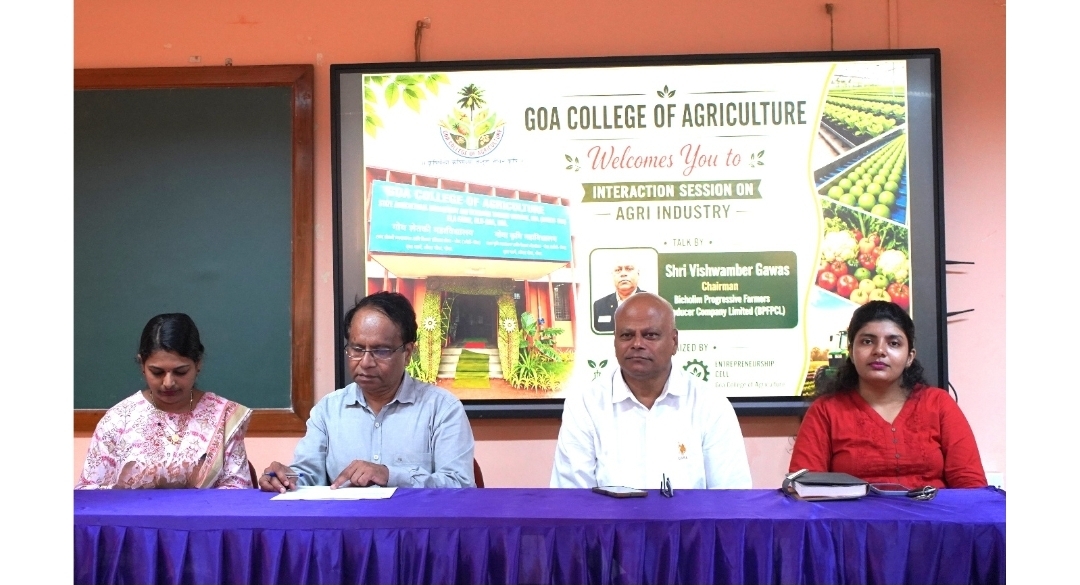
OLD GOA, AUGUST 27: The Training and Placement Cell (TIP) and Entrepreneurship Cell of the Goa College of Agriculture organised an Interaction Session on Agri-Industry at ELA Farm, Old Goa, on Thursday, providing students practical exposure to entrepreneurship, Farmer Producer Organisations (FPOs), value addition and market development in the agriculture sector.
The programme was coordinated by TIP Coordinator Dr. Rachana Kolambkar and Entrepreneurship Cell Coordinator Bhushan Sawant Dessai. The session aimed at broadening students’ understanding of agriculture beyond conventional crop production by introducing them to the entire agricultural value chain — from production and aggregation to processing, value addition, marketing and consumer access.
Principal Dr. Suresh Kunkolikar welcomed the resource persons and students and highlighted the importance of practical interactions in expanding the professional outlook of agriculture students.
The resource persons were Vishwambar Gawas, Chairman of Bicholim Progressive Farmers Producer Company Limited (BFPCL), farmer and agri-business entrepreneur, and Siya Shetkar, District Coordinator associated with Cluster Based Business Organisation (CBBO) activities in Goa.
Gawas spoke extensively on FPOs, crop diversification, value addition and direct market linkages. Explaining the objectives of the Government of India’s 10,000 FPO initiative, he cited the Bicholim FPO as an example of how collective input procurement, aggregation, processing and marketing could strengthen farmers’ bargaining power.
He also stressed the importance of bringing fallow and barren land under productive cultivation and shared practical experiences of using private machinery and power tillers for agricultural operations in Khazan lands.
Highlighting opportunities in locally suitable crops, Gawas discussed kokum, black pepper and moringa. He said kokum planting material had been distributed among FPO shareholders with the objective of developing a future raw-material base for value-added products such as kokum syrup and dried rind.
Moringa, he said, offered scope for multiple sources of income. Sharing his own experience, Gawas said he cultivated around 500 moringa plants with okra as an intercrop. While okra generated early returns, moringa leaves were subsequently harvested, dried and processed into powder.
He encouraged students to explore the commercial potential of different parts of agricultural produce instead of restricting themselves to selling raw crops.
Gawas also highlighted the importance of reducing dependence on intermediaries through direct market linkages, FPO-to-FPO transactions and inter-state trade. The role of the Goa State Horticulture Corporation Limited in organised vegetable procurement was also discussed. Students were encouraged to explore online marketplaces such as Amazon and Flipkart for marketing processed and value-added farm products.
Siya Shetkar, meanwhile, shared her professional journey from working as an apprentice and data associate in areas including documentation, the Economic Survey and Agricultural Economics to gaining experience with NABARD and state-level coordination.
She highlighted the development of moringa powder as a value-added “superfood” product, explaining how research, institutional inputs, processing and understanding market demand could help transform an agricultural crop into a commercially viable product. She said academic resources, including Google Scholar, along with inputs from ICAR and the Agriculture Department, were used in developing the initiative, which also received appreciation from Chief Minister Dr. Pramod Sawant.
She stressed that modern agriculture requires a combination of technical knowledge, agricultural economics, research, innovation, entrepreneurship, communication, networking and market understanding. She also briefed students about CBBO-related opportunities and encouraged them to remain connected with professional and institutional networks.
The interaction gave students practical insights into FPO functioning, Krishi Card registration, fallow-land utilisation, intercropping, processing, institutional procurement, value addition, inter-FPO trade and digital marketing.
The speakers urged students to view agriculture not merely as crop cultivation but as a potentially profitable enterprise in which local agricultural resources can be converted into higher-value products through innovation and effective market linkages.
The programme concluded with a vote of thanks proposed by Maithili Shetye. Organisers said the interaction served as a bridge between classroom education and the agri-industry, encouraging students to approach careers in agriculture with greater entrepreneurial thinking, innovation and market awareness.