Gaonkaari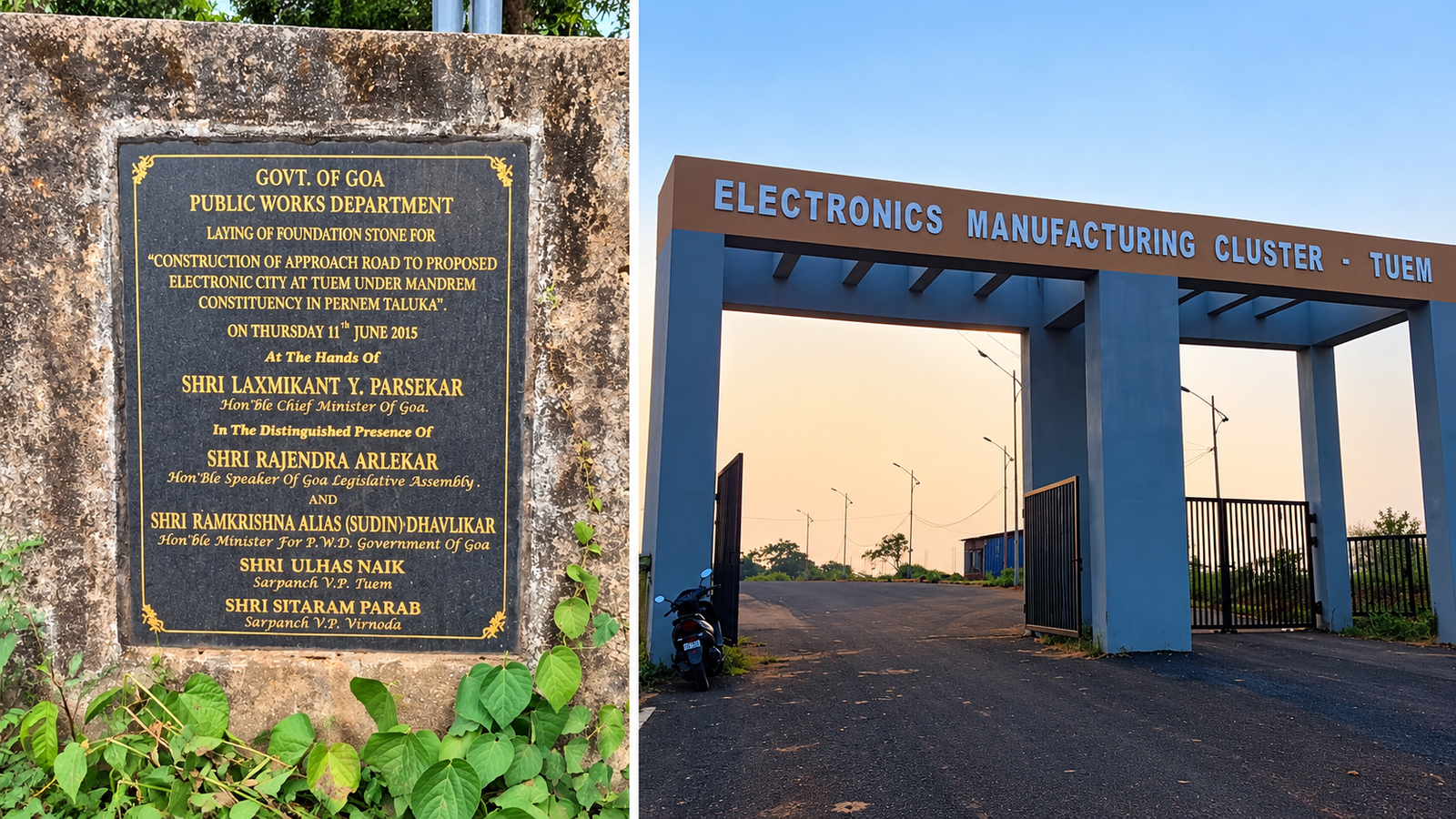
Putting the Cart Before the Horse: ₹140-Crore Convention Centre Takes Priority While Goa’s Electronics Manufacturing Cluster Struggles for Basic Infrastructure
Is public land acquired for industrial development being diverted towards commercial real estate at the cost of local employment, manufacturing growth and the promises made to Pernem’s youth?
By Jose Lobo
Secretary, Tuem Nagrik Samiti
The Electronics Manufacturing Cluster (EMC) at Tuem, Pernem, was conceived as a symbol of Goa’s industrial future. Promoted under the ambitious national vision of Make in India, the project promised to transform the region into a centre for electronics manufacturing, technological innovation and skilled employment.
For the people of Tuem and Pernem, this was not merely another government project. It represented the promise of economic opportunity, employment for educated local youth and a future beyond dependence on tourism and traditional occupations.
Agricultural land was acquired, public resources were committed, and substantial central assistance was extended to develop the industrial ecosystem.
Today, however, a disturbing question confronts the government: Was the Electronics Manufacturing Cluster established to manufacture electronic products or to create lucrative commercial real estate opportunities?
The latest proposal for a ₹140-crore International Convention Centre within the EMC raises serious concerns about the direction in which this publicly supported industrial project is heading.
A ₹140-Crore Commercial Dream Amid Industrial Neglect
The Goa Department of Information Technology, Electronics and Communications has floated a Request for Proposal (RFP) for developing an International Convention Centre on approximately 23,988 square metres of land within the Tuem EMC.
The proposed development reportedly includes a 2,500-seat convention facility, a 50-room business hotel, food courts, retail establishments and other commercial amenities under a 30-year Public-Private Partnership arrangement.
The justification offered is that such infrastructure would attract major technology companies and international investment.
But this explanation raises a fundamental question.
How can a luxury convention centre become a priority when the manufacturing cluster itself is still struggling to secure essential industrial infrastructure?
A convention centre cannot manufacture a single electronic component. A luxury hotel cannot substitute for an industrial testing laboratory. Premium restaurants cannot replace dependable water supplies, adequate logistics facilities or affordable production infrastructure.
Yet these are precisely the priorities that appear to have been reversed.
Where Are the Roads, Water and Technical Facilities?
An electronics manufacturing cluster cannot survive on promotional brochures, investment summits and impressive architectural designs.
It requires a functioning industrial ecosystem.
Manufacturers need reliable heavy-vehicle access roads, dependable industrial water supplies, efficient logistics, testing and certification laboratories, common warehousing facilities, technical support centres and uninterrupted utilities.
Concerns have been raised that Tuem EMC still lacks adequate dedicated industrial road connectivity and an independent high-capacity industrial water supply system.
These are not optional conveniences. They are foundational requirements for manufacturing operations.
Local micro, small and medium enterprises engaged in electronics and related equipment production need practical industrial support to remain competitive.
Without these facilities, the very enterprises that the cluster was supposed to encourage could find themselves struggling with higher operating costs and logistical disadvantages.
Instead of first addressing these deficiencies, the authorities appear determined to introduce an expensive commercial development.
This is not industrial planning. It is putting the cart before the horse.
Public Industrial Land or Private Commercial Opportunity?
The proposed allocation of nearly 24,000 square metres for a commercial hospitality and convention project deserves intense public scrutiny.
Land within an industrial cluster is a valuable public resource. Its use must remain consistent with the original objectives, approved master plan and conditions attached to public funding.
The central question is whether this land could better serve the manufacturing ecosystem through common technical facilities, component testing laboratories, precision tool rooms, shared warehouses, logistics infrastructure and other industrial utilities.
Once a substantial parcel is committed to a long-term commercial concession, future flexibility in industrial planning could be seriously restricted.
A private developer investing approximately ₹140 crore will naturally seek commercial returns.
Given the proximity of Tuem to Manohar International Airport at Mopa, there is a legitimate concern that the proposed convention centre and hotel could increasingly cater to high-end corporate events, destination celebrations, exhibitions and tourism-related activities rather than the day-to-day requirements of local manufacturers.
Would small industrial units be able to afford the facilities developed on land originally intended to support their industrial ecosystem?
Would the proposed development genuinely strengthen electronics manufacturing, or would it effectively introduce an independent hospitality business into a publicly supported industrial estate?
These questions demand transparent answers before any irreversible commitment is made.
What Happened to the Promise of Employment?
The original justification for establishing the Tuem EMC was closely associated with industrial investment and employment generation.
For Pernem’s educated unemployed youth, the promise of skilled jobs in electronics manufacturing was particularly significant.
The government must now disclose how many manufacturing units have actually commenced operations, how many permanent jobs have been created, how many local residents have benefited and how much of the promised industrial infrastructure has been completed.
It must also explain how the proposed convention centre will contribute directly to the manufacturing objectives of the cluster.
Employment generated by hotels, catering establishments and event management businesses cannot automatically be presented as equivalent to the skilled manufacturing employment originally promised.
Both sectors may create jobs, but they serve fundamentally different economic purposes.
The people of Tuem surrendered land for an industrial future. They deserve to know whether that future is being replaced by a commercial venture.
A New Threat to Local Water Resources?
The proposed commercial development also raises serious environmental and resource-management concerns.
A 50-room hotel, large convention facility, food courts and associated commercial establishments would require substantial water supplies, wastewater management and other utility services.
At a time when questions remain about adequate industrial water infrastructure, the authorities must explain how the additional requirements of the proposed project will be met.
Will the facility depend on groundwater extraction? Will its requirements affect surrounding villages? Has a credible water availability assessment been conducted?
These issues cannot be brushed aside through assurances.
A comprehensive water-resource assessment, environmental appraisal and infrastructure-capacity study should be made public before proceeding.
Industrial development must not come at the expense of the basic needs of neighbouring communities.
MeitY Must Examine the Proposed Land Use
The Ministry of Electronics and Information Technology (MeitY), which has supported the development of electronics manufacturing clusters under the national EMC framework, must examine whether the proposed commercial development is consistent with the sanctioned objectives of the Tuem project.
The government should place the original Detailed Project Report, approved land-use plan, funding conditions, subsequent modifications and relevant approvals in the public domain.
It must establish whether the proposed convention centre is an approved component of the industrial cluster or represents a material departure from the original project.
If the project involves any change in approved land use, the legal basis and competent authority’s approval must be clearly disclosed.
The public also deserves an explanation of why a substantial commercial investment is being prioritised when essential industrial requirements reportedly remain incomplete.
Transparency is not an obstacle to development. It is the foundation of legitimate development.
Tuem Cannot Be Reduced to a Real Estate Experiment
The objections raised by the Tuem Nagrik Samiti and concerned local residents must not be dismissed as opposition to development.
There is a fundamental difference between opposing industrial progress and questioning a development model that appears to compromise the original purpose of an industrial project.
The people of Tuem are entitled to demand that public land and public money be used for the objectives for which they were originally committed.
Their concerns regarding employment, infrastructure, environmental sustainability and commercialisation deserve serious consideration.
The government must not confuse expensive construction with meaningful economic development.
A convention centre may produce impressive photographs and inauguration ceremonies. But it cannot, by itself, establish a sustainable electronics manufacturing ecosystem.
That requires functioning factories, competitive enterprises, technical capabilities, skilled workers and dependable infrastructure.
The Government Must Answer Five Questions
Before proceeding with the proposed ₹140-crore project, the Goa government must answer:
1. Why is a convention centre being prioritised before essential industrial roads, water supply and common technical facilities are fully operational?
2. Does the proposed commercial development conform to the original EMC project approvals, land-use conditions and central funding requirements?
3. How many manufacturing units and permanent local jobs have actually materialised against the original commitments?
4. What safeguards will prevent the proposed convention centre and hotel from becoming primarily commercial hospitality facilities unrelated to electronics manufacturing?
5. Were the Tuem Panchayat, affected landholders, local residents and existing industrial stakeholders meaningfully consulted before the RFP was issued?
These are questions of public accountability, not political convenience.
Suspend the RFP, Review the Priorities
The Tuem Nagrik Samiti calls for the immediate suspension of the proposed convention centre RFP pending an independent review of the project’s compliance with its original objectives and approval conditions.
MeitY should examine the proposed allocation of land, the utilisation of central assistance, the status of industrial infrastructure and the extent to which the project has fulfilled its employment and manufacturing commitments.
The state government must prioritise essential infrastructure and place all relevant documents before the public.
Any proposed commercial component should be considered only after its necessity, legality, financial implications and direct benefits to the electronics manufacturing ecosystem have been convincingly established.
Tuem was promised an Electronics Manufacturing Cluster, not a luxury commercial enclave.
The government must decide whether it wants to build an industrial economy that empowers local youth or promote commercial structures that may primarily benefit private investors.
Goa does not need another expensive monument to misplaced priorities.
It needs functioning industries, meaningful employment, transparent governance and responsible use of public land.
Let factories come before five-star facilities. Let jobs come before grand conventions. Let the original promise to Tuem take precedence over commercial ambitions.
Because if an Electronics Manufacturing Cluster cannot first provide the basic infrastructure needed to manufacture electronics, the question is unavoidable:
Is Tuem EMC becoming a manufacturing hub—or merely another gateway to commercial real estate?