Gaonkaari
PANAJI, October 13: With Goa heading towards the 2027 Assembly elections, the protection of agricultural land, hills, forests and village landscapes is emerging as a significant public policy issue. At the centre of this debate is the proposed Goa Protection of Agricultural Lands Act, 2026, drafted by retired Justice Ferdino Rebello and submitted to all members of the Goa Legislative Assembly.
Proposed legislation seeks repeal of TCP Section 39A, restrictions on hill cutting, protection of paddy fields and agricultural land, review of controversial land conversions and tighter controls on transfer of farmland to non-agriculturists.
The proposed legislation seeks far-reaching changes to Goa’s existing land-use and planning framework. Rather than addressing individual land conversions or development permissions in isolation, the draft attempts to establish a comprehensive legal mechanism for protecting agricultural land, restricting environmentally damaging development and preventing the diversion of land from its original purpose.
The proposal brings together amendments to the Goa Town and Country Planning Act, the Goa Restrictions on Transfer of Agricultural Land Act, 2023, and the Goa, Daman and Diu Land Revenue Code. It also seeks to strengthen the protection of Comunidade land and agricultural tenancy rights.
With the draft now placed before legislators, its proponents intend to make it a central issue in the forthcoming Assembly elections, bringing the future of Goa’s land resources into the political discussion.
Repeal of Section 39A: A central demand
One of the most significant provisions of the proposed legislation is the repeal of Section 39A of the Goa Town and Country Planning Act.
Introduced through a 2024 amendment, Section 39A has become a major point of contention in the debate over changes to land-use zoning in Goa.
The draft argues that Section 39A was introduced to overcome restrictions under Section 16A, which regulates development in accordance with the Regional Plan 2021.
According to the explanatory document accompanying the draft, Regional Plan 2021 was finalised after considering objections and suggestions from local bodies, non-governmental organisations and other stakeholders.
The document maintains that approximately 400 square kilometres of land had already been earmarked for settlement purposes under the Regional Plan, providing scope for residential and other development.
It therefore questions the necessity of allowing additional conversions of agricultural, orchard and environmentally sensitive land into settlement zones.
The draft claims that, at the time of its preparation, approximately 68,65,609 square metres of land had been converted from categories including orchard, natural cover, paddy fields, cultivable land, agricultural land, forest and non-developable slopes into settlement zones. It further states that additional conversions subsequently took place.
These figures, presented by the proponents, would require independent verification against official TCP records.
The proposed law seeks to repeal Section 39A retrospectively from February 22, 2024, subject to the legislation being enacted in its proposed form.
It also proposes invalidating specified permissions that contravene agricultural land protection and related laws, notwithstanding court judgments or decrees. Such retrospective provisions could become a major subject of legislative and constitutional scrutiny.
Stronger protection against hill cutting and land filling
The proposed amendment to Section 17A of the TCP Act represents another important feature of the draft.
The existing framework allows certain activities involving hill cutting or filling of low-lying land subject to permissions from the planning authorities.
Justice Rebello’s draft proposes a general prohibition on cutting hilly land, sloping land and non-developable slopes, as well as filling low-lying areas.
The prohibition would apply not merely to landowners but also to occupiers, their agents, servants and other persons undertaking such activities.
The proposal nevertheless provides a limited exception for projects genuinely serving the public interest.
Under this exception, the Chief Town Planner (Land Use) could grant permission for specified development involving land with a gradient below 25 per cent or low-lying land, provided the statutory conditions are satisfied.
Importantly, the proposed provision would require public objections to be invited through publication in the Official Gazette and at least two regional newspapers circulating in the locality.
The authority would also be required to record the reasons for granting permission in the public interest.
This would introduce a more transparent decision-making process, giving affected residents an opportunity to object before permission is granted.
The draft defines hilly or sloping land by reference to a gradient of 1:10 or greater, while slopes exceeding 25 per cent are classified as non-developable. Low-lying land is defined with reference to land situated at least 50 centimetres below adjoining ground level.
Survey of India topographical contour data would be used for calculating gradients.
However, the proposed restrictions contain an express exemption for activities undertaken pursuant to permissions or licences under the Mines and Minerals (Development and Regulation) Act, 1957, and the rules framed under it.
That exemption is particularly relevant in Goa, where mining activity and environmental protection remain closely connected public concerns.
Review of permissions granted after September 2023
The draft also addresses permissions granted following a Town and Country Planning Board decision taken at its 189th meeting on August 28, 2023, and an order issued on September 6, 2023.
It proposes declaring specified permissions granted after September 6, 2023, null and void, including permissions covered by the proposed retrospective amendment.
For applications where permissions have already been granted but occupancy certificates have not been issued before the proposed Act comes into force, the draft provides for reconsideration in accordance with the explanatory memorandum issued by the Chief Town Planner on January 29, 2010.
The memorandum relies on contour plans prepared by the Surveyor General of India.
This provision could have significant consequences for projects that have received planning permissions but have not reached completion.
At the same time, retrospective cancellation of permissions could raise questions about vested rights, investments made in reliance on official approvals, judicial decisions and the rights of affected landowners.
The draft’s attempt to invalidate permissions notwithstanding court judgments would require particularly careful constitutional examination.
Paddy fields to remain agricultural regardless of zoning changes
A central objective of the proposed legislation is to prevent agricultural land from losing its protected status merely because its zoning classification has been changed.
The draft proposes amendments to the Goa Restrictions on Transfer of Agricultural Land Act, 2023, by expanding the definition of agricultural land.
Under the proposed definition, agricultural land would include land presently used for paddy cultivation, land leased for paddy cultivation under agricultural tenancy laws, land covered by relevant Comunidade provisions, and land designated as A1–Agriculture in an Outline Development Plan or as paddy fields in Regional Plan Goa 2021.
This would address a concern raised by land protection advocates: that agricultural land could potentially be brought within a developable zone through planning amendments, thereby weakening its original protection.
The proposed amendment makes the intended restriction explicit: agricultural land cannot be used or permitted to be used for purposes other than agriculture.
Even if the zoning of a paddy field were changed to settlement or another developable category, the proposed law would continue to prohibit its conversion to non-agricultural use.
The significance of this proposal extends beyond planning regulations. It attempts to establish agricultural land protection as a substantive legal restriction rather than a classification that can be altered through the planning process.
Special protection for Comunidade lands
Goa’s traditional Comunidade system also receives specific attention in the draft.
The proposal refers to Article 31A of the Code of Comunidades, under which land granted for a particular purpose cannot be diverted to another purpose contrary to the applicable legal provisions.
The explanatory document states that land granted by a Comunidade through licence, lease, sale or emphyteusis for one purpose should not be converted for another purpose and that, where the proposed conditions apply, such land would revert to the Comunidade.
The draft also seeks to strengthen the process for determining whether a particular property qualifies as agricultural land.
Under the proposed amendment to Section 3(4) of the 2023 agricultural land legislation, the Mamlatdar would conduct an inquiry and invite public objections through the Official Gazette and at least two regional newspapers.
For land falling within a Comunidade, the Mamlatdar would be required to consider the purpose for which the property was originally granted, with reference to records including Tombo I and Tombo II.
Relevant entries in Form I and Form XIV of the Record of Rights, together with agricultural tenancy provisions, would also have to be examined.
The proposal is intended to ensure that decisions concerning agricultural land are based not merely on contemporary zoning classifications but also on historical land records, original grants and legally recognised agricultural rights.
Restrictions on the sale and transfer of agricultural land
One of the draft’s most consequential provisions concerns who may acquire agricultural land and for what purpose.
Through a proposed Section 22A of the Goa, Daman and Diu Land Revenue Code, the legislation seeks to restrict the transfer of agricultural land through sale, lease, gift or other instruments.
Such transfers would be permitted only for agricultural purposes and to eligible agriculturists.
The proposed provision also introduces a residential requirement: an individual acquiring agricultural land should ordinarily have resided in Goa for at least 30 years.
The explanatory document states that the intention is to prevent the transfer of agricultural land to non-agriculturists and its diversion to non-agricultural purposes.
This would represent a substantial change in the legal framework governing agricultural land transactions.
Its implications would extend to landowners, tenant farmers, prospective purchasers and those acquiring agricultural properties for investment.
The 30-year residence condition could also invite constitutional and legal examination, particularly concerning equality, permissible restrictions on property transactions and the precise definition of an eligible agriculturist.
The proposed law would therefore need clear procedures for verifying eligibility and resolving disputes.
Reversal of the 2024 Land Revenue Code amendments
The draft additionally proposes repealing the Goa Land Revenue Code (Amendment) Act, 2024, identified as Goa Act 20 of 2024, along with the rules framed under it.
The proposed repeal would operate retrospectively from November 7, 2024.
Together with the insertion of Section 22A, this measure seeks to restore stronger restrictions on the use and transfer of agricultural land.
Rather than treating planning permissions, revenue classifications and land transfers as separate administrative matters, the draft attempts to connect them within a single protective framework.
Its central proposition is that agricultural land should remain agricultural regardless of subsequent changes in ownership or zoning, unless specifically permitted under applicable law.
Carrying capacity and the future of Goa’s villages
Beyond its individual legal provisions, the draft raises the broader question of whether Goa’s villages possess sufficient infrastructure and natural resources to accommodate continuing development.
The explanatory document identifies pressure on water supply, electricity, sewerage and sewage disposal systems as consequences associated with extensive land conversions.
It argues that large-scale conversion of agricultural and environmentally sensitive land into settlement zones can impose additional burdens on villages that are not equipped for rapid expansion.
The question of carrying capacity has also been emphasised by Justice Rebello in public discussions about Goa’s future.
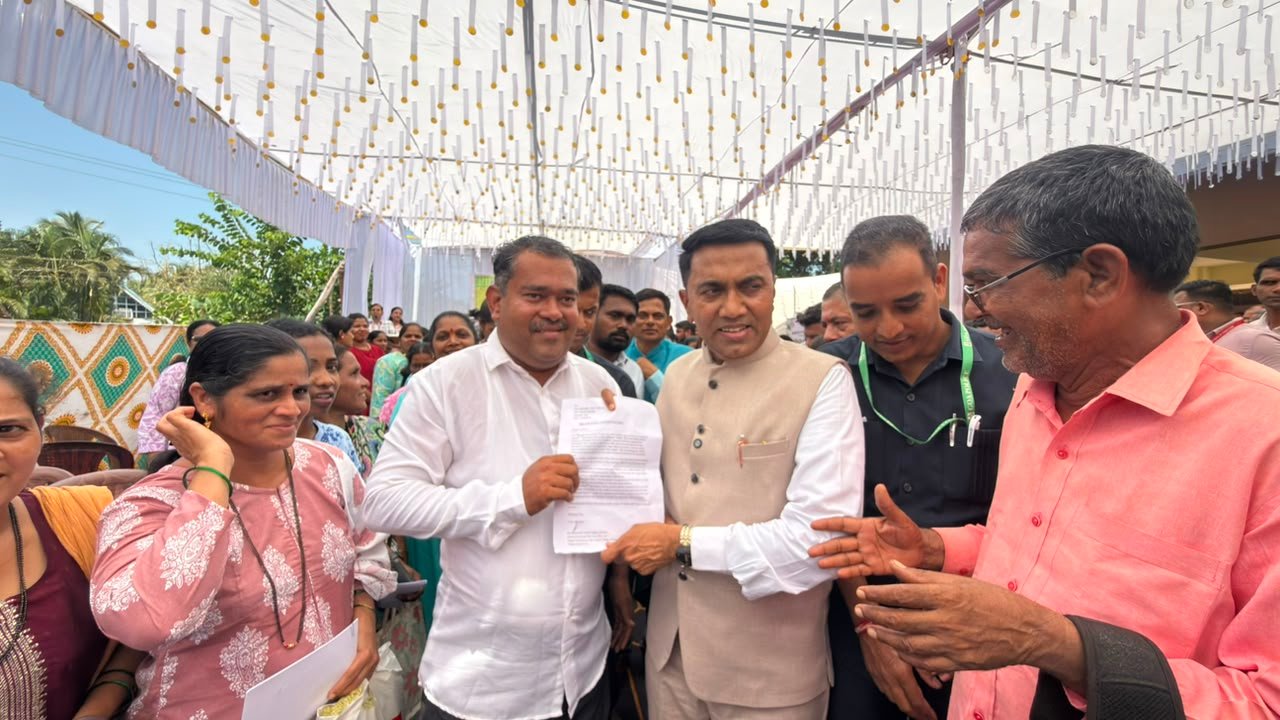
At a recent community interaction in Telaulim, he stressed the need to assess development against available infrastructure, environmental resources and obligations towards future generations.
The proposed legislation does not itself establish a comprehensive carrying-capacity assessment mechanism. Nevertheless, its restrictions on land conversion and hill cutting are intended to address some of the pressures associated with expanding development.
The wider policy question is whether the state should permit additional development through individual zoning decisions without first assessing cumulative impacts on infrastructure, ecology and local communities.
From citizens’ movement to legislative proposal
The draft legislation forms part of the broader campaign undertaken by the Enough is Enough, Goa movement, led by Justice Ferdino Rebello.
The movement has consistently raised concerns about amendments to land-use laws, the protection of agricultural land, the destruction of hills and the need to preserve Goa’s natural and cultural identity.
Its citizens’ charter called for the repeal of controversial planning amendments and restrictions on the transfer of agricultural land to non-agriculturists and non-residents.
The legislative initiative has already entered the political process.
In February 2026, Justice Rebello circulated the draft among political parties and legislators. Goa Forward Party president and Fatorda MLA Vijai Sardesai subsequently submitted it as a private member’s Bill, identified in reporting as Bill No. 22 of 2026.
Justice Rebello also sought the reconvening of the Assembly to consider the proposed legislation following developments surrounding the Ponda by-election in April.
These developments demonstrate that the proposal has progressed beyond a general environmental demand into a specific legislative initiative.
However, submission or introduction of a Bill does not mean it has become law. Its provisions would require legislative approval and completion of the applicable constitutional process before acquiring legal force.
Assembly elections: A test of political commitments
With the 2027 Assembly elections approaching, the proposed Goa Protection of Agricultural Lands Act creates an opportunity for political parties to clarify their positions on land-use policy.
The debate is no longer limited to whether individual development projects should be permitted or opposed.
It concerns the legal principles that should govern future development, the status of agricultural land, the powers of planning authorities and the rights of local communities.
The draft raises several questions for legislators and political parties.
Will they support the repeal of Section 39A? Are they prepared to reconsider permissions granted under disputed planning provisions? Do they favour stricter protection of paddy fields and agricultural tenancy land? What safeguards should govern hill cutting and filling of low-lying areas? Should agricultural land transactions be restricted to eligible agriculturists with long-term residence in Goa?
Equally important is how parties proposing changes to existing land laws intend to balance environmental protection, housing requirements, infrastructure development, farmers’ rights and legal certainty for property owners.
The government’s position and the views of parties that support the existing planning framework will be important to a complete public debate.
The proposed Bill is likely to face questions concerning the practicality of retrospective cancellation, the legal validity of residence-based restrictions, the exemption for mining activities and the administrative mechanisms needed to enforce its provisions.
These are substantive issues that require legislative examination rather than merely political declarations.
A question of land, livelihood and future generations
The Goa Protection of Agricultural Lands Act, 2026, is notable for attempting to combine several existing legal issues within one legislative framework.
Its proposed repeal of Section 39A addresses zoning changes. The amendment to Section 17A addresses hill cutting and filling of low-lying land. The changes to agricultural land legislation seek to protect paddy fields irrespective of zoning classifications. The amendments to the Land Revenue Code address the transfer and continued agricultural use of farmland.
Taken together, these measures seek to change how agricultural and environmentally sensitive land is regulated in Goa.
The proposal also places the relationship between development and environmental protection at the centre of the discussion.
Goa requires housing, public infrastructure, economic activity and employment. At the same time, agricultural land, water resources, hills and traditional village landscapes are finite resources.
The central challenge for lawmakers is to establish a framework that accommodates legitimate development while preventing unlawful or environmentally damaging changes in land use.
For Justice Ferdino Rebello and the Enough is Enough movement, the proposed legislation provides a concrete basis for demanding legislative action.
For political parties, it presents a set of specific provisions on which their positions can be examined.
For voters, it provides an opportunity to evaluate not only public statements about protecting Goa but also the legal measures that parties are prepared to support.
As Goa moves towards the 2027 Assembly elections, the proposed law places a fundamental policy question before the state: how should Goa balance its development needs with the long-term protection of its agricultural land, natural resources and village communities?
The answer will depend not only on electoral promises but also on the laws eventually enacted, the safeguards included and the seriousness with which those laws are implemented.