Gaonkaari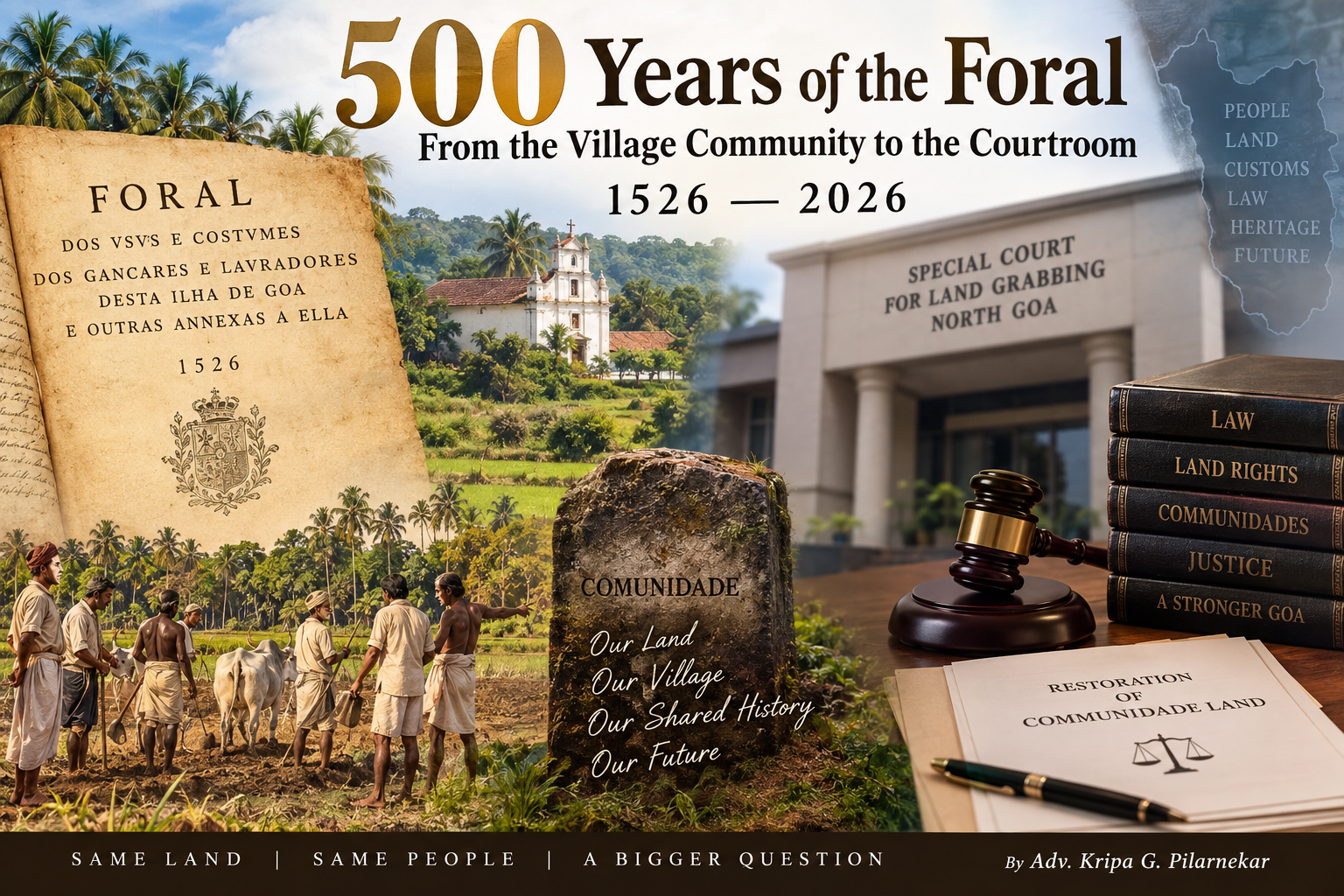
1526–2026: 500 Years of the Foral From the Village Community to the Courtroom
By Adv. Kripa G. Pilarnekar
On 16 September 1526, the Foral dos usos e costumes dos Gancares e Lavradores desta Ilha de Goa e outras annexas a ella recorded the uses, customs and practices governing the Gaunkars and cultivators of Goa. Exactly five hundred years later, on 16 September 2026, that history has acquired striking contemporary relevance as questions concerning Communidade land return to the courtroom.
The Communidades are not merely remnants of Goa’s past. They form part of the State’s shared historical inheritance. These village institutions have survived changes in rulers, legal systems, religion, politics and economic structures over several centuries.
Their history cannot be viewed through the prism of one religious or social community. It is intertwined with the history of Goa’s villages and of both Hindu and Catholic Goans.
That is why the present issue should not be reduced to one community against another. The larger question is whether a centuries-old system governing village lands, community rights and customary institutions can be protected in an era of rapidly increasing commercial pressure on land.
Five Centuries Later, a Legal Battle
On 16 September 2026—the 500th anniversary of the Foral—I instituted a Special Civil Suit before the Special Court for Land Grabbing, North Goa, seeking restoration of Communidade land at Dhargal, Pernem, to the Gauncars and the Communidade, and ultimately to its original agricultural, forest and community use.
At the heart of the case lies a fundamental question:
Can land possessing a special historical and legal character as Communidade property be treated as ordinary private real estate and brought under commercial or single-family control?
Goa undoubtedly has the right to develop. Development, however, must take place within the framework of law.
The market value of land, fiscal grants or the payment of 20 years’ foro (rent) cannot, by themselves, conclusively determine or alter the underlying legal character of Communidade property. The crucial question must always be how rights over the land were created, transferred, recorded and ultimately recognised.
Follow the Paper Trail
Where Communidade land is alleged to have been improperly diverted, an investigation cannot stop with the name currently appearing in Form I & XIV.
It must follow the entire chain of title and possession.
Who originally obtained control over the land? Under what authority was that control granted or recognised? What instrument was used? Which public authorities approved or facilitated the transaction? During whose tenure were the relevant decisions taken? And, ultimately, through what process did the names of private persons come to be reflected in the revenue records?
These questions matter because once community land passes into private hands, the controversy goes far beyond physical possession.
It becomes a question of how public authority, private interests and official land records interacted to alter control over land historically associated with a village community.
Revenue records may tell us whose name appears today. They do not necessarily answer the more important historical and legal question: How did that name get there?
Development Cannot Erase History
The purpose of invoking the Foral today is not to turn Goa’s clock back by 500 years.
It is to ensure that five centuries of community history cannot simply be erased by a few decades of land transactions, conversions or changes in revenue records.
The Foral’s references to Gaunkars, village lands, cultivation, succession, dues, customs and village administration remind Goa of the institutional heritage it inherited. The legal struggles of the present generation will determine how much of that heritage survives for the next.
Communidade land is therefore about more than acreage.
When land historically belonging to village institutions comes under private or commercial control, what may be lost is not merely property. Goa also risks losing community participation, collective decision-making and the influence that villages historically exercised over their own land.
Five hundred years after the Foral, Goa therefore faces a question that is both historical and contemporary:
If Communidade land has been diverted, should an enquiry end with the name presently appearing in Form I & XIV? Or must it examine the entire chain of title and possession—who obtained the land, under whose authority, during whose tenure, through what instrument and by what process community property came to be reflected in favour of private persons?
The more pertinent question is not simply whose name stands in the revenue record today.
The question is how that name came to stand there in the first place.
The Foral of 1526 tells us what Goa inherited.
The challenge of 2026 is to decide, within the framework of law, what Goa will preserve.