Gaonkaari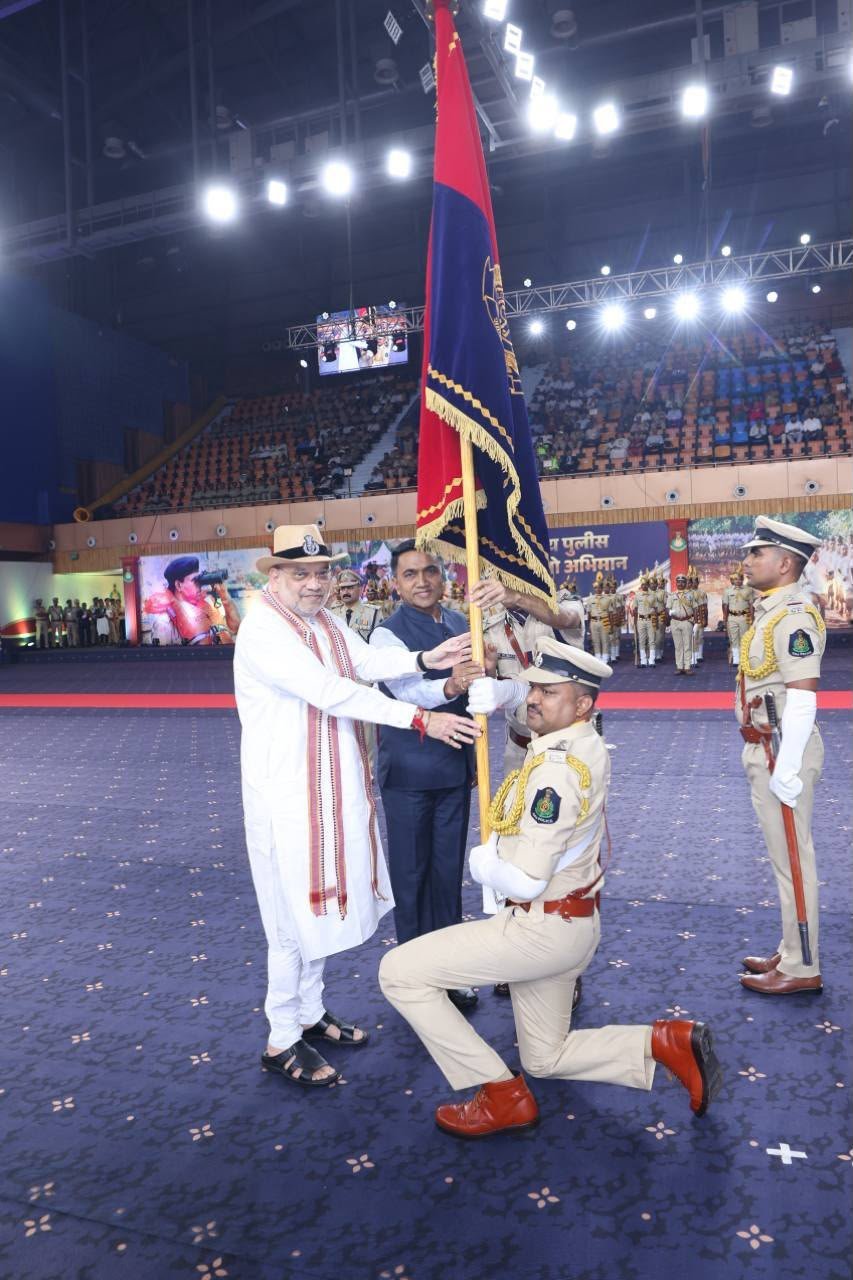
The President’s Colour, popularly known as Rashtrapati ka Nishan, is not an ordinary decoration. It is among the highest institutional honours that can be bestowed upon a police or disciplined force. It represents national recognition of courage, professionalism, distinguished service and institutional excellence.
Precisely because the honour carries such enormous prestige, the process by which it is awarded must command the same degree of respect.
An honour becomes truly meaningful not merely because of the grandeur of the ceremony, but because the public can clearly understand why it was conferred, what exceptional achievements justified it, and what distinguished the recipient from its peers.
Goa Police receiving the President’s Colour is undoubtedly a proud moment for the force. The ceremony at the Shyama Prasad Mukherjee Indoor Stadium, where Union Home Minister Amit Shah presented the Colour on behalf of the President, marked an important milestone in the history of policing in Goa.
It is an occasion to celebrate.
But celebration should never exclude scrutiny. In fact, the greater the honour, the stronger the case for transparency.
From an Instrument of Repression to a Democratic Police Force
Goa Police carries a history unlike that of many other state police forces.
Its institutional roots predate Liberation. The Polícia do Estado da Índia (PEI) was established by the Portuguese regime in April 1946. Until then, policing and maintenance of law and order were largely handled by the Portuguese military.
The PEI emerged at a politically turbulent moment. Dr Ram Manohar Lohia’s civil disobedience movement had ignited a new phase of resistance against Portuguese rule, and the colonial police subsequently acquired notoriety for its brutal suppression of the freedom movement.
Liberation on December 19, 1961 therefore represented much more than a political change. It demanded an institutional transformation—from a force serving a colonial regime to one functioning under the Constitution and laws of democratic India.
N. R. Nagu became the first Inspector General of Police of liberated Goa. Indian policing systems, laws and procedures were introduced, and a major reorganisation followed the recommendations made by B. Shetty, Additional DGP in the CBI, after his 1965 study of the force.
I had the privilege of serving alongside some of the old-timers who belonged to that period of transition. When I entered the service, many were approaching retirement. They came from a very different era of policing, but I remember their discipline, commitment and loyalty to the uniform.
That institutional journey deserves recognition.
Over the decades, Goa Police has changed enormously. Technology has transformed investigation. New security challenges have emerged. Community policing has received greater emphasis. Specialised units have developed, while forensic capability, coastal security, intelligence and anti-narcotics operations have assumed increasing importance.
The motto Shanti, Seva, Nyaya—Peace, Service and Justice—captures what a democratic police force is ultimately expected to represent.
But a motto acquires meaning only when citizens experience it.
Why Was Goa Police Chosen?
This is where the larger question begins.
The reasons cited for conferring the President’s Colour include policing excellence, modernisation, infrastructure, specialised security capabilities and public-safety initiatives. Improvements in law-enforcement infrastructure, forensic capabilities, modern technology, coastal security, intelligence, anti-narcotics operations and initiatives such as the Pink Force have been highlighted.
All of these are undoubtedly important.
But are they, by themselves, sufficient evidence of exceptional institutional performance?
Modern buildings do not automatically produce better policing.
Sophisticated equipment does not automatically produce better investigations.
Technology does not automatically produce justice.
And the creation of a specialised force does not automatically establish its effectiveness.
Take the Pink Force.
The objective behind it is commendable. Women’s safety deserves dedicated attention. But if the Pink Force is cited as evidence of policing excellence, citizens are entitled to know its measurable record.
How many cases has it handled? How many interventions resulted in meaningful action? What has been its response time? What do women who have approached it say about their experience? Has it produced a measurable improvement in safety or confidence?
These are not hostile questions.
They are the questions that transform a government claim into a verifiable achievement.
The same test should apply to modernisation, forensics, intelligence, coastal security and anti-narcotics operations.
If forensic capabilities have improved, have investigations become faster and stronger?
If technology has improved, has detection improved?
If anti-narcotics capability has strengthened, what measurable impact has it had on the drug problem?
If policing has become more citizen-friendly, has public confidence correspondingly increased?
Infrastructure is an input. Technology is an input. Specialised units are inputs. Excellence must ultimately be measured by outcomes.
That distinction is important.
Prestige Demands Transparency
This is not an attempt to belittle Goa Police or deny credit to its officers and personnel.
Quite the opposite.
An institution genuinely deserving of such a prestigious honour has nothing to lose from greater transparency. It has everything to gain.
The Ministry of Home Affairs’ 2025 guidelines are therefore significant because they introduce eligibility requirements and measurable indicators relating to police-public ratio, representation of women, public safety, technology, training, welfare and major achievements.
That is welcome.
But the expanding list of police forces receiving the President’s Colour inevitably raises another question: what precisely distinguishes the exceptional from the merely eligible?
Gujarat received the Colour in 2019, Himachal Pradesh in 2021, Assam and Tamil Nadu in 2022, Haryana in 2023 and Chhattisgarh in 2024.
There is no obvious and consistent electoral pattern to these awards. Some preceded elections; others followed them. I therefore make no allegation that electoral considerations determined these decisions.
My concern is more fundamental.
If the President’s Colour represents exceptional professional achievement, the comparative basis for selecting one force over another should be visible enough to inspire confidence.
What benchmarks were achieved?
What exceptional results were demonstrated?
How did the recipient perform against comparable police forces?
What tipped the balance in its favour?
The answers should not remain buried inside administrative files.
Prestige grows through transparency; it does not diminish because of it.
An Honour Belonging to Generations
None of these questions should take away from what this moment means for Goa Police.
The force has travelled an extraordinary distance—from its difficult origins in 1946, through the upheaval of Liberation and institutional reconstruction, to the modern police organisation of today.
Generations of officers, constables, investigators, drivers, wireless personnel, technical staff and countless others have contributed to building this institution.
Many served without publicity.
Many worked in difficult conditions.
Some displayed exceptional courage.
Others quietly upheld the dignity of the uniform over decades.
The President’s Colour therefore cannot belong merely to those occupying senior positions today. It belongs equally to generations of policemen and women whose names may never appear on a ceremonial programme but whose service built the institution receiving this honour.
As a retired IPS officer, I was honoured to have been invited to the presentation ceremony. I attended alongside former colleagues and saluted those presently serving. The ceremony was impressive and the parade displayed discipline and professionalism worthy of the occasion.
I remain proud of the khaki I once wore.
I was once a citizen in uniform. Today, I remain a policeman without the uniform—a citizen who continues to believe deeply in the service.
But pride in an institution should never mean suspending questions about it.
The challenges facing today’s police are far more complex than many of those we encountered during my years of service. Technology can help fight crime. Better training can strengthen investigations. Modern forensic tools can improve prosecution. Professional policing can increase public confidence.
But the greatest challenge is not technological.
It is institutional.
Can a police force remain professional when confronted with political pressure? Can it enforce the law without fear or favour? Can an ordinary citizen expect the same response as the powerful and well-connected? Can the uniform retain its independence within the political and administrative system?
Those are the real tests of policing excellence.
A President’s Colour is an extraordinary honour. But it must never become merely another ceremonial flag attached to a uniform.
It should become a daily reminder of a much greater obligation.
Every complaint fairly heard.
Every investigation professionally conducted.
Every citizen treated with dignity.
Every political pressure resisted.
Every exercise of police power subjected to law.
That is what Shanti, Seva, Nyaya must ultimately mean.
The Colour may be bestowed in a ceremony. Its prestige, however, must be earned every single day on the street, in the police station, during an investigation and in the manner the weakest citizen is treated.
Goa Police has received the President’s Colour.
The greater responsibility begins now: to prove, through its conduct and performance, that the institution continues to deserve it.
B.George Retired IPS