Gaonkaari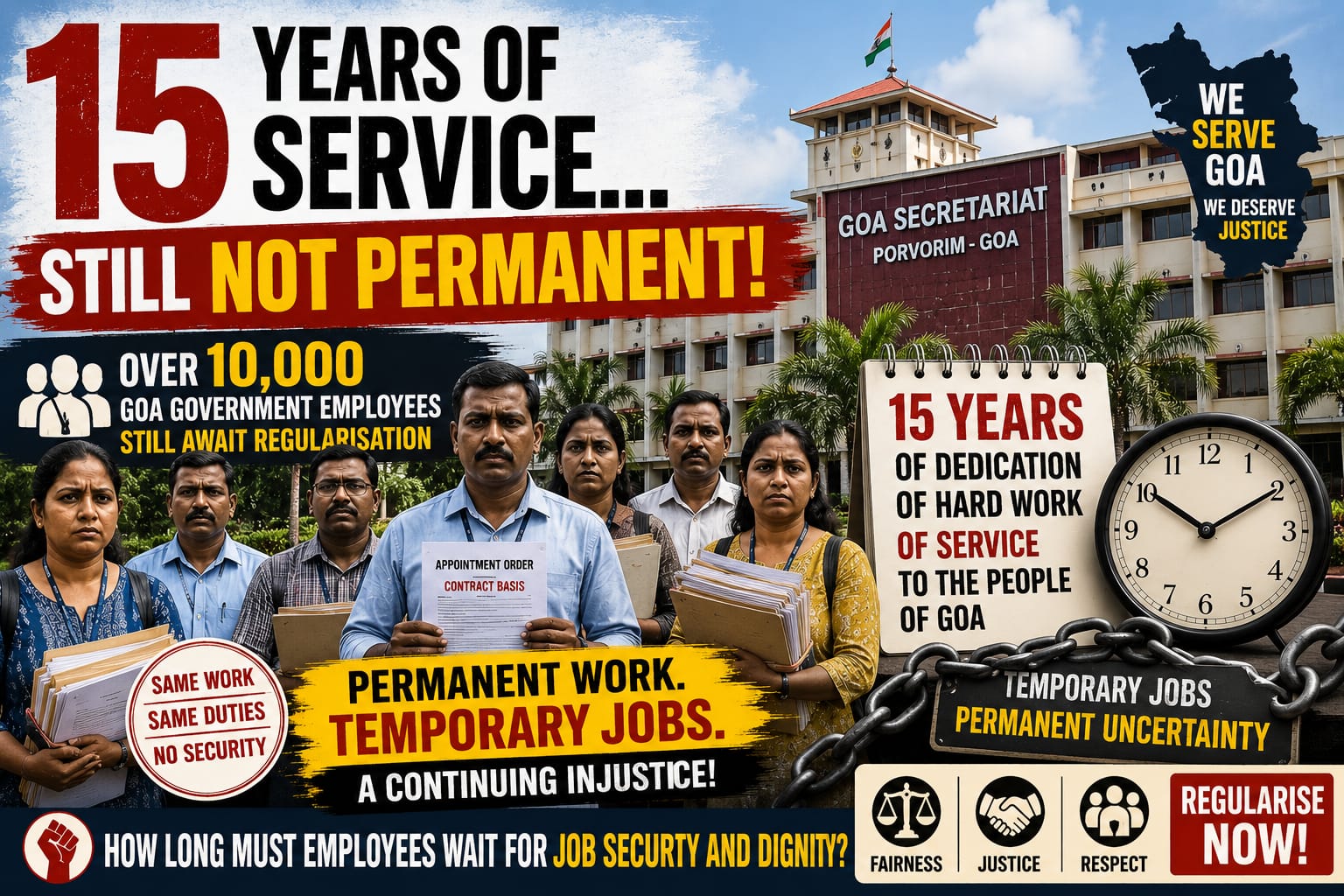
By Kishor Naik Gaonkar For years, successive governments in Goa have spoken about employee welfare, good governance and social justice. Yet, one of the most glaring injustices within the government system continues to be ignored — the plight of thousands of contractual, temporary and daily-wage employees who have dedicated the prime years of their lives to public service without any guarantee of job security.
It is estimated that more than 10,000 individuals are currently working in various government departments, corporations and autonomous bodies on contractual, temporary or similar arrangements. Many of these employees have completed not just five or ten years of service, but in numerous cases over fifteen years. Despite rendering continuous service and performing duties identical to those of regular employees, they continue to live under the constant fear of uncertainty.
The fundamental question is simple: If the work is permanent, why should the employees remain temporary?
Government departments continue to depend heavily on these workers for their day-to-day functioning. Schools, hospitals, municipal bodies, administrative offices and various public services would struggle to operate efficiently without their contribution. Yet, while the government benefits from their labour, these employees are denied the security, benefits and dignity enjoyed by regular staff.
What is even more concerning is the government’s apparent preference for introducing schemes such as “temporary status” rather than formulating a comprehensive policy for regularisation. While such schemes may provide marginal benefits, they do not address the core issue. Temporary status is not a substitute for permanent employment. It merely prolongs uncertainty and institutionalises insecurity.
The Supreme Court has repeatedly emphasized that governments cannot exploit workers through perpetual temporary appointments. In various judgments, the judiciary has underscored that workers performing regular and perennial duties should not be kept on temporary arrangements indefinitely. The spirit of the law is clear: the State, being a model employer, cannot engage in practices that would be unacceptable in the private sector.
Particularly relevant are judicial observations that employees cannot be engaged for years together on temporary arrangements when the work itself is of a permanent nature. Governments cannot create a parallel workforce deprived of basic employment protections while continuing to extract regular service from them.
The irony is difficult to ignore. Governments frequently speak about protecting workers’ rights, labour welfare and social justice. Yet thousands of employees serving the government itself remain trapped in precarious employment conditions. Many have crossed the age limits for seeking alternative employment elsewhere. They have spent their most productive years serving public institutions with the expectation that loyalty and dedication would eventually be recognised.
Beyond the legal and administrative dimensions lies a human story. These employees support families, educate children, repay loans and contribute to the economy. The uncertainty surrounding their future creates enormous financial and emotional stress. No worker who has devoted fifteen or more years to public service should be forced to wonder whether their employment will continue the following year.
The Government of Goa must acknowledge this reality and initiate a transparent policy framework for regularisation. Such a policy should be based on objective criteria, length of service, qualifications and performance. It should not be driven by political considerations or selective implementation.
Regularisation is not merely an employment issue; it is a question of justice, fairness and human dignity. A government that relies on the services of these employees year after year cannot continue to deny them security indefinitely.
The time has come for the Government of Goa to move beyond temporary status schemes and provide a permanent solution. After fifteen years of service, employees should not still be waiting for recognition. They deserve certainty, respect and the opportunity to serve with dignity.
A welfare state cannot be built upon the insecurity of its own workforce. The government must act now and ensure that those who have spent years serving the public are not forgotten by the very system they helped sustain.